Gli arredi sono composti principalmente di pannelli e di vernici. Proprio per questo è importante che le materie prime siano di altissima qualità, non solo per la salute dei consumatori, ma anche per il rispetto dell’ambiente.
Questa è la scelta che è stata fatta per i materiali che compongono gli arredi Moretti Compact, per garantire un prodotto finito bello e sicuro.
Il materiale principale utilizzato nella produzione Moretti Compact (Moretti Italian Design S.p.A) è un agglomerato di particelle di legno riciclato, fornito in pannelli di vari spessori. I pannelli maggiormente utilizzati sono:
Il Pannello LEB rappresenta il pannello ecologico a più bassa emissione di formaldeide al mondo, realizzato al 100% con materiale legnoso post-consumo certificato FSC 100% Recycled* e con valori di emissioni addirittura inferiori ai limiti imposti dal regolamento F****.
In Europa il limite attuale è fissato a 0,1 ppm (parti per milione) ed il pannello corrispondente è chiamato E1.
In Giappone c’è una classificazione delle emissioni in funzione della destinazione d’uso del prodotto, in questo caso i pannelli sono classificati da F* a F****.
In California, da sempre lo stato più attento ai temi dell’ecologia e della salute sul suolo americano, una legge stabilisce nuovi limiti di emissione per tutti i prodotti a base legno, che dovranno essere entro i 0,09 ppm, e il pannello corrispondente è chiamato “CARB P2”.
Le emissioni del LEB si collocano addirittura al di sotto del valore giapponese F**** (il più severo) e ben 5 volte più basse dell’ E1.
I valori di emissione del Pannello Ecologico LEB sono già oggi a 0,04 ppm.
FSC (Forest Stewardship Council) è da molti anni l’ente certificatore più prestigioso a livello mondiale in termini di prodotti provenienti da foreste certificate.
FSC è anche riconosciuto come simbolo di salvaguardia e rispetto forestale e ottenere tale certificazione significa ormai riuscire a dare ai propri consumatori precise certezze. La certificazione afferma che tutto il legno con cui il Pannello Ecologico viene realizzato è legno riciclato post-consumo.

| spessore 6 mm | Pannelli di particelle di legno legate con resina classe CARB P2 - FSC, nobilitati con pellicola in PVC/PPL in finitura Ardesia. |
| spessore 8 mm | Pannelli di particelle di legno legate con resina classe CARB P2 - 100% legno riciclato - FSC, nobilitati con carte melaminiche in finiture essenze o laccati colori a campionario. |
| spessore 12 mm | Pannelli di particelle di legno legate con resina classe LEB o CARB P2 - 100% legno riciclato - FSC, nobilitati con carte melaminiche in finiture essenze o laccati colori a campionario. |
| spessore 12 mm | Pannelli di particelle di legno legate con resina classe CARB P2 - FSC, nobilitati con pellicola in PVC/PPL in finitura Ardesia. |
| spessore 18 mm | Pannelli di particelle di legno legate con resina classe LEB o CARB P2 - 100% legno riciclato - FSC, nobilitati con carte melaminiche in finiture essenze o laccati colori a campionario. |
| spessore 22 mm | Pannelli di particelle di legno legate con resina classe LEB o CARB P2 - 100% legno riciclato - FSC, nobilitati con carte melaminiche in finiture essenze o laccati colori a campionario. |
| spessore 25 mm | Pannelli di particelle di legno legate con resina classe LEB o CARB P2 - 100% legno riciclato - FSC, nobilitati con carte melaminiche in finiture essenze o laccati colori a campionario. |
| spessore 38 mm | Pannelli di particelle di legno legate con resina classe E1 - 100% legno riciclato - FSC, nobilitati con carte melaminiche in finiture essenze o laccati colori a campionario. |
I bordi utilizzati sui lati a vista dei pannelli sono in ABS spessore 0,4 - 0,8 mm. e risultano conformi alla normativa europea EN 71.3 e 71.9, mentre i bordi secondari sono in melamminico spessore 0,3 mm.

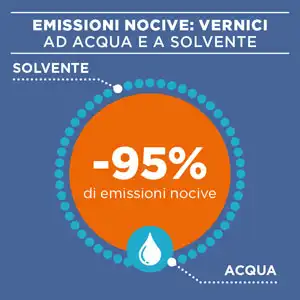
Moretti Compact utilizza vernici all’acqua per realizzare camerette di qualità, dimostrando impegno non solo nei confronti dell’ambiente ma anche per la salute dei consumatori e di chi lavora nei reparti di verniciatura.
L’innovativo sistema di laccatura utilizzato in azienda, riduce l’emissione nell’ambiente di sostanze nocive fino al 95% rispetto alle tradizionali vernici a solvente.
I prodotti laccati con queste vernici vengono, infatti, certificati in accordo con:
Per garantire maggiore sicurezza di utilizzo, le vernici all’acqua impiegate da Moretti Compact per le parti laccate sono dotate di un additivo igienizzante che preserva le superfici dalla proliferazione dei batteri.